

Gosport Half was my first organised event of the year and, also the furthest I’ve run in one go since March. I’m writing this in mid-November, so as you can gather, I haven’t run much lately. After a long period of rehab for a stubborn hamstring tendinopathy, I am gently building my mileage back up, a process I’ve openly shared with fellow runners. My struggle with OCD however, I’ve only shared with a tiny handful of people, despite it affecting my running and its impact on my life being far greater. Having run 12 marathons last year, 2025’s plot twist was discovering I’d need to pour more energy than I’d used in all of those into getting help for my mental health and engaging with the treatment. I could no longer ignore my symptoms, which by March had reached a paralysing and confusing crescendo, making it hard for me to leave the house, and then, be in the house (figure that one out!). Much like running, we keep going with a niggle, hoping it will go away, until one day something goes twang.
I decided to run Gosport Half at the last minute. I wasn’t sure if I should do it, not because I didn’t think my leg was ready for the distance but because I was scared of my OCD showing up. This, I’ve learned through treatment, meant it was the right thing to do. Damn, OCD is so tricksy!
At the same time as signing up to run, I decided I wanted to write a piece about my experience on the day. Before I had a diagnosis, I was desperately seeking examples of people going through similar things and struggled to find articles I could relate to, especially in the running sphere. Searching for ‘running + anxiety’ returned countless results on the benefits of running for mental health but very little from people who have a more complex relationship with physical activity. Equally, the typical portrayal of OCD in the media as principally a ‘neatness illness’ contributes to misinformation about the condition, or in my case, not understanding I had it despite experiencing symptoms for many years.
Whilst I can appreciate a colour-matched running coord as much as the next person, I’ve learned that OCD can present itself in many guises, impacting on any thought, person or subject, from identity and contamination, to harm and hyperawareness of bodily sensations (sensorimotor), the latter two being some of the themes I experience. It is characterised by obsessions or intrusive thoughts which are highly distressing, and compulsions, things you feel you have to do either physically or in your head, to make the distress or uncertainty go away. It can be sticky, changing and attaching to new things, which before I understood the underlying cause, had left me feeling like I was playing whack-a-mole with seemingly random ‘crazy’ fixations and rituals. These typically impact the things we love most, our values and our beliefs, which is one of the reasons OCD is so upsetting, and since running was practically my identity for a time, it made sense eventually to stick to that.
Three years ago, I ran Gosport Half, lining up with nerves about getting a new PB and a London Championship qualifying time. This year, I stood on the start line anxious about whether my legs would seize up, scared my body would suddenly become a stiff, uncoordinated mess, disassociated from my brain, floating somewhere above as crowds looked on aghast. Basically, I would become Pinocchio. Whilst you might not be able to relate to the fear of turning into a wooden puppet, I think this touches on many common anxieties associated with performance – perfectionism and the fear of losing control, dealing with the unknowns and the what ifs, and feelings of shame.
My goal this year for Gosport wasn’t to set a good time. It wasn’t even to ‘have fun’, the consolation prize I’d often set myself in previous races only to feel like I’ve failed that too – not fast or happy! My goal was simply to keep running no matter how I felt. If OCD showed up, I would run with it, lean into my fear and let it in. Because really it is already there, and the more I try to block it out or run away, the bigger it gets, and the smaller my world becomes.
Last year I ran 12 marathons (did I mention that?). This year, one of my biggest achievements has been to run 30 seconds on a treadmill. Reframing what success looks like has been critical to my progress. Success for me now is keeping going ‘in spite of’. I have worried about what success looks like for other people – good times, PBs, placing, prizes, and not meeting the expectations of myself and others. Before entering Gosport, I toyed with the idea of not even registering as a club member, not wearing a vest, somehow erasing my time off the website, my Power of 10 besmirched! I fantasised about running incognito or finding some industrial estate to run round in private instead of doing the real race, like a running pariah, where people could stand and point and laugh and maybe throw rotten tomatoes. Thinking like this has kept me from showing up in the past, waiting for just the right moment, when the risk of failure and embarrassment is as small as I can possibly make it. The problem with this approach is that these ‘perfect’ moments are extremely rare and waiting for one to come along, I was missing out on experiences, the opportunity to learn and build my confidence, and the potential to actually just have fun. Yes, I do believe that is possible.
In many ways, Gosport was the ideal race to come back to after injury. It’s flat, it’s local, it’s good value and well organised and it’s a significant enough size to have people turn out to cheer you on. It’s two laps of the seafront so, all being good with the wind, it’s simple to pace. And they do a great goody bag, especially if cake bars are your thing. I knew it would be a good course for my hamstring to go the distance but I was worried about the monotony of it for my mind; loops with few landmarks, hills or technical terrain to negotiate, all changes that help me stay in the present moment rather than wandering off into the realm of thought, or as I call it, my back brain. But as I’ve said, this was even more reason to do it.
I didn’t go into the race cold. Just like rehabbing my leg, I have been working on my mind for the best part of a year. Alongside medication and Exposure and Response Prevention therapy, the absolute cornerstones of my treatment, I have been training in mindfulness with Oxford Mindfulness Foundation. Mindfulness has received a lot of hype and like many things that get a lot of attention (…and marketing), the hype doesn’t always accurately reflect the true essence of the subject. I have found it hard to engage with meditation in the past but OMF’s structured learning, evidence-based approach and daily practice has clicked for me. Jon Kabat-Zinn, founder of Mindfulness-Based Stress Reduction, compares regular practice to a parachute: ‘make sure you weave your parachute every day, rather than leave it to the time you have to jump out of the plane.’ I was standing on the start line with a solid block of brain training under my belt – my parachute was packed.
There were familiar faces and new faces too – all offered me warm smiles and hellos – I knew wearing the vest was a good decision.
I found a spot around the 1:45 finish time marker and gravitated towards a cluster of red, white and black vests. There were familiar faces and new faces too – all offered me warm smiles and hellos – I knew wearing the vest was a good decision. The collective body heat that was another welcome benefit of being bunched up but as the clock approached 10am, I started to visualise myself freezing up. I felt myself descending into rumination, analysing the warm-up strides I’d taken earlier with cold stiff legs, wanting the thoughts not to happen, trying to think myself out of that state.
Moments like these, I used to desperately try to put my mind somewhere else, to block it out, to escape. Now I know, the pathway through is to stay right where I am, to be present with the thoughts and feelings and relate to them differently. I focused on the sensation of my feet contacting the ground, moving intentionally to explore the shifting areas of pressure as I leant into my toes, then my heels. Then I shifted to my breath, noticing how it changed, from the cold air in my nostrils as I breathed in, to expanding my belly and the warm exhale. Buoyed by practicing ‘in the field’, I was ready to go.
The start was a challenge. The klaxon sounded and everyone poured down the starting funnel. I was surrounded by ragged breathing, people making a hard start, jostling for space. The nervous energy bouncing around felt tangible and it was hard to keep centred but after 2k, I had found my own rhythm and was enjoying running in a group, my head up, feeling strong with a nice spring in my step. It was dry and there was hardly any noticeable wind, unlike the first time I ran Gosport where I got a welcome push down the seafront but had to battle back the other way. The race had quickly spread out and there was plenty of room. I started to be able to take in faces of people clapping on the verges and felt happy to be out participating.
After a short incline, I could make out the leaders heading back down the promenade. I saw Glenn, my husband looking very comfortable in a group and gave him an encouraging shout out. The course continued downhill to the turning point at the beach and along the promenade, I enjoyed a drumming band, something I have struggled with in the past when loud beats and rhythms have played into my sense of overwhelm. As the race moved back onto the road, I saw Harry and James and exchanged smiles and waves, giving me another boost.
I was approaching the half-way turn when I started to unravel. The wind became stronger, and my legs felt heavy. I felt like I was moving through thick soup. A sense of panic was growing. I touched my mental parachute chord: this is exactly why I’m here, to practice keeping going, I told myself. Half-way felt long in coming but I kept running, intentionally leaning into the feelings, running with them rather than trying mental gymnastics to block them out. I recalled work I’d done in treatment where Glenn filmed me running in this state – despite what I thought my body was doing, how out of control I felt, I looked perfectly composed. I was reminded how I can’t always trust how I interpret the signals from my body, and this helped me move from thinking mode into direct experience. I focused on a point right between my shoulder blades. This spot felt warm, stable, reassuringly unmoving. Whilst my legs were clamouring for anxious attention, there were parts of my body quietly getting on with feeling fine, and these were the ones I chose to focus on.
As I approached the seafront for the second time, I realised that I was back in a rhythm. It’s funny how thoughts can rise up and melt away. I was soon joined by Steve Oliver, we chatted and I felt a real bounce in my stride again, as I moved with ease and the time ticked by effortlessly. Back down to the beach, I had left Steve but not without saying he’d pass me at the windy bit (which he surely did!). I turned onto the prom where I saw Cathy looking strong and got a cheer from Sarah Gurney. Again, I was thankful for choosing to wear the vest. As I entered the last couple of kms, I started thinking about the parts of the course where I had tied up on the first lap and if panic would set in as I approached the line, the wheels coming off with all eyes on me. I chose to focus on the present: I was running, I didn’t need to change anything, and I could just keep going.
Wearing the WRC vest, I got to feel the compassion of others, and to be part of something more.
I finished with Glenn egging me on over the line. He’d run an excellent race, great time, great pacing and I was proud. And, in what is still a very new experience for me, I was proud of myself for showing up. Did my fears and fixations show up too? Yes. Did I keep running? Yes. That was my measure of success. I know there are no quick fixes and changing my beliefs and behaviour takes practice. To use the parachute analogy, I’ve been weaving away and today I drew on all my supportive threads. It also takes self-compassion. Wearing the WRC vest, I got to feel the compassion of others, and to be part of something more. As I reflected on the race, it was that feeling of acceptance which stuck with me. Most of all, I was excited to have run, and for all the other opportunities I can take, even with fear. ‘Just do it’.
Maybe I should get that printed on a t-shirt…
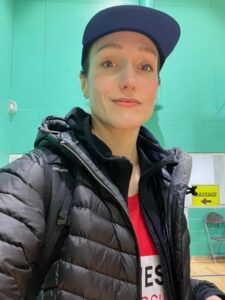
Before…..
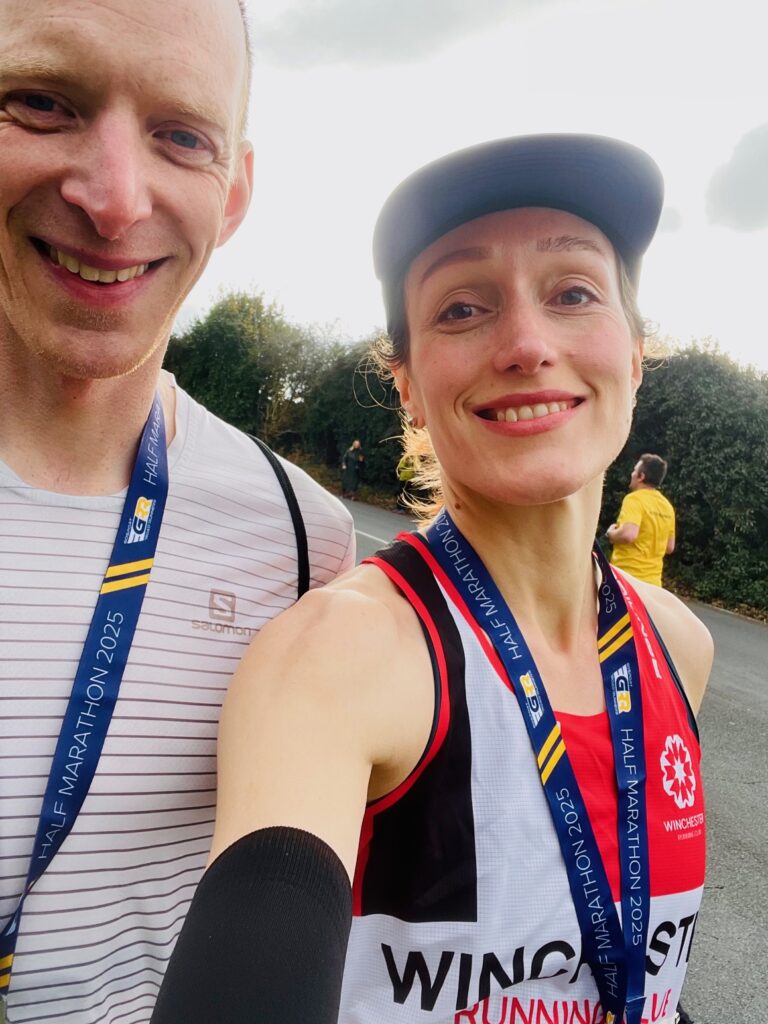
….and after!